ZH
ZH  EN
EN 

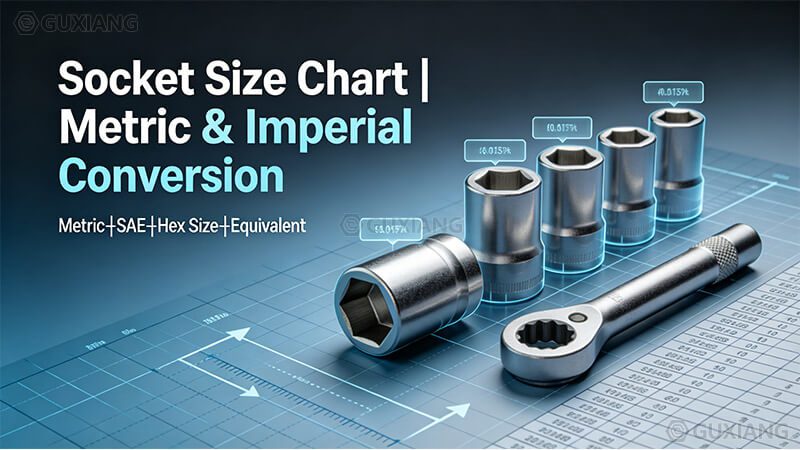
With the range of drive sizes, measurement systems, and head types in regular use, a quick reference can save time and prevent damaged hardware. This chart brings those details into one place, showing common socket sizes and how they relate to both inch and metric fasteners, and their corresponding drive sizes. Whether you're working on automotive repairs, machinery maintenance, or general assembly, this guide helps you select the correct socket every time.
| Metric Size | |
| Imperial Equivalent | |
| Drive Size | |
| Common Application |
| Metric (mm) | Imperial (inches) | Drive Size | Common Application |
|---|
The drive size determines which ratchet or wrench handle you need. Larger drives handle more torque but require more space. Here's a quick reference for matching socket sizes to drive sizes:
| Drive Size | Metric Range | Imperial Range | Typical Use |
|---|---|---|---|
| 1/4" | 2mm – 7mm | 5/64" – 9/32" | Electronics, small appliances, precision work |
| 3/8" | 6mm – 14mm | 1/4" – 9/16" | Automotive, motorcycles, general assembly |
| 1/2" | 8mm – 25mm | 5/16" – 1" | Automotive, heavy machinery, wheel lug nuts |
| 3/4" | 24mm – 36mm | 15/16" – 1-7/16" | Trucks, heavy equipment, industrial machinery |
| 1" | 36mm – 50mm | 1-7/16" – 2" | Heavy industrial, construction equipment |
Choosing between 6-point and 12-point sockets affects both grip strength and ease of use. Here's how they compare:
| Feature | 6-Point Socket | 12-Point Socket |
|---|---|---|
| Contact Points | Flat sides of fastener | Corners of fastener |
| Torque Capacity | Higher — less risk of rounding | Lower — more risk of rounding |
| Engagement Angle | Every 60 degrees | Every 30 degrees |
| Tight Space Use | Limited swing arc needed | Easier in confined spaces |
| Best For | High-torque, rusty, or stubborn fasteners | General assembly, speed work |
| Common Sizes | All standard sizes | All standard sizes |
Socket size refers to the across-flats measurement of the opening — the distance between two parallel flat sides of the hexagonal opening. A 10mm socket fits a bolt head that measures 10mm across its flats.
Metric sockets are measured in millimeters (mm), while imperial sockets use fractions of an inch. They are not interchangeable — a 10mm socket is close to but not exactly 3/8" (9.525mm). Always use the matching system.
Shallow (standard) sockets work for exposed fasteners. Deep sockets are approximately twice as long, designed for fasteners on long studs or recessed in holes. Both types are available in the same size range.
Spark plug sockets come in 14mm, 16mm (5/8"), 18mm, and 21mm (13/16") sizes. They feature a rubber insert or magnet to protect the ceramic insulator and often have a thin wall to fit into deep spark plug wells.
For a 10mm bolt, you need a 10mm socket. The socket size corresponds to the across-flats dimension of the bolt head or nut. A 10mm socket typically uses a 3/8" drive and is one of the most commonly used sizes in automotive and general assembly work.
A 6-point socket contacts the flat sides of a fastener, providing maximum torque transfer and reducing the risk of rounding. A 12-point socket contacts the corners, allowing you to engage the fastener at twice as many positions (every 30 degrees instead of 60 degrees), making it easier to use in tight spaces. For high-torque applications, 6-point sockets are preferred.
Drive size depends on the socket size and application: 1/4" drive for small sockets (2-6mm), 3/8" drive for medium sockets (6-14mm), 1/2" drive for larger sockets (8-25mm), and 3/4" drive for heavy-duty sockets (27mm and above). Larger drives handle more torque but require more clearance space.
Metric and imperial socket sizes don't convert exactly. For example, 10mm is approximately 3/8" (9.525mm), and 13mm is approximately 1/2" (12.7mm). Always use the correct system socket for the fastener to avoid rounding. Use our chart above for exact reference between metric and imperial equivalents.
The most commonly used socket sizes are 10mm, 13mm, and 17mm for metric fasteners, and 3/8", 1/2", and 3/4" for imperial fasteners. These sizes cover the majority of automotive, machinery, and general assembly applications. A basic socket set with these sizes handles most everyday tasks.
It is not recommended. While some metric and imperial sizes are close (e.g., 13mm and 1/2"), they are not identical. Using the wrong system can strip the fastener corners, damage the socket, or cause injury. Always match the socket system to the fastener system for safe and effective work.
Most spark plugs use either 16mm (5/8") or 21mm (13/16") sockets. Some older vehicles may use 18mm or 14mm. Always check your vehicle's service manual for the correct spark plug socket size. Spark plug sockets often include a rubber insert to protect the ceramic insulator during removal and installation.
A shallow (standard) socket is about as tall as the socket's width and works for most exposed fasteners. A deep socket is approximately twice as long, designed to reach fasteners on long threaded studs or recessed bolts. Both come in the same size range and drive configurations. Choose based on the fastener's accessibility.
Social Chat is free, download and try it now here!