ZH
ZH  EN
EN 

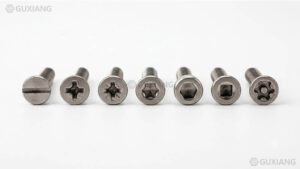
Phillips vs Torx vs Flat Head is the screw-drive comparison we get asked most, and the answer is simpler than the wall of bits at the hardware store suggests. These three drives sit at opposite ends of one spectrum: Phillips is engineered to cam out, Torx resists it almost perfectly, and the flat head (slotted) transfers the least torque of the three. Below we settle Phillips vs Torx vs Flat Head with hard numbers: torque ceilings, cam-out thresholds, tool cost, and a decision matrix you can apply to any job.
Mike, a cabinet installer in Austin, has been there more times than he likes to admit. Last March he watched three deck screws wallow out in a row under his impact driver, each head twisting into a shiny, useless crater. That wreckage was not clumsiness. It was a Phillips recess meeting more torque than its taper was built to hold, the single most common avoidable defect on job sites and assembly lines alike.
We wrote this for buyers, engineers, and DIYers who specify fasteners and want the argument settled without a sales pitch. You already know a screw needs a recess for the driver; what you may not have pinned down is which recess keeps your torque spec intact under a power tool and vibration. By the end you will read a drive symbol, predict its torque ceiling, and pick the right one for the joint in front of you.
A screw drive is the recess cut into the top of a fastener, the shape your tool grips. Phillips, Torx, and slotted are all drive types. That sounds obvious until you meet the term most people actually confuse it with: the head type, which is the screw’s external shape (pan, button, countersunk). The two are independent and can be mixed freely: a pan head can carry a Torx recess, and a countersunk head can carry a Phillips one.
This distinction matters because “flat head” is the trap. In head-shape language, flat head means a screw that sits flush (countersunk). In drive language, flat head means a single straight slot. This article uses flat head as a drive, the slotted recess, and we link out to the complete guide to screw head types wherever the two meanings could collide.
If you have ever grabbed the wrong driver and stripped a screw, that mix-up is usually the cause. The screw drive overview on Wikipedia catalogs all 30-plus systems; we are narrowing to the three you will actually argue about.
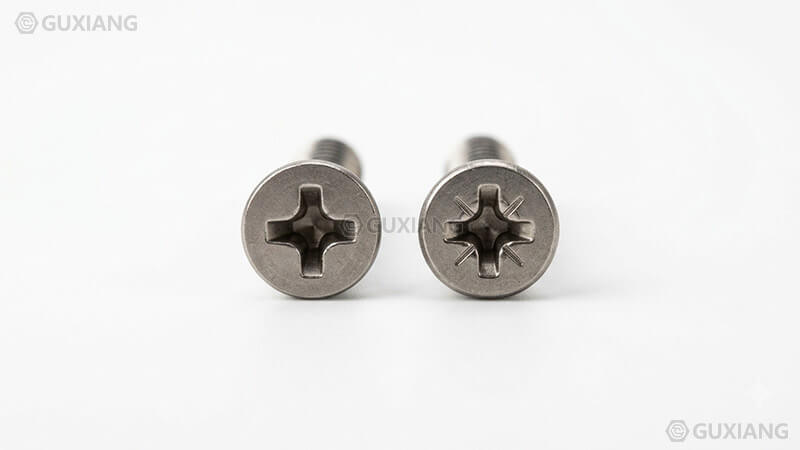
The Phillips drive is a crossed recess with tapered, conical flanks, patented by Henry Phillips in 1936. The taper is the whole story: as torque rises, the angled walls convert rotational force into an outward wedge that gently ejects the bit. That “cam-out” was a feature, not a bug. On a moving assembly line, a bit that popped free at a preset torque stopped workers from over-driving soft parts.
Nine decades later, that same behavior is why Phillips still strips under a cordless driver. The trade you inherit is a slip-safe limit in exchange for lower torque ceiling. Phillips sizes run PH0–PH4; PH2 is the workhorse you meet on #6–#12 screws daily, PH1 serves electronics, and PH3–PH4 handle heavier structural work.
Why use Torx screws? Plainly: near-zero cam-out, 4–6× the usable torque of Phillips, and the longest reuse life of the three.
Strengths: bits are everywhere and cheap, the slip limit protects delicate assemblies, and it remains the North American default.
Weaknesses: it cams out by design, transfers the least torque of the three common cross-style drives, and offers no self-centering.
Torx, developed by Camcar Textron in 1967 and standardized as ISO 10664, swaps the taper for six parallel lobes with near-vertical flanks. Torque no longer wedges the bit out; it pulls the bit in. The result is near-zero cam-out and the highest torque ceiling of any common drive. Sizes run T1–T100, with T10–T30 covering most work and T20/T25 the everyday standards for decking, automotive trim, and enclosures.
In a head-to-head bench test on M6×20 Grade 10.9 pan-head screws (torxscrew.com), Torx delivered 25 N·m of max torque transfer versus 18 N·m for Phillips, a 39% edge, and a cam-out threshold of 28 N·m versus 15 N·m, an 87% improvement. The Torx bit also lasted 5,000+ insertions before wear versus 1,500 for the Phillips bit, and the screw survived 50+ drive cycles versus roughly 15.
Strengths: near-zero cam-out, 4–6× the usable torque of Phillips, and the longest reuse life.
Weaknesses: a 5–15% per-fastener premium (princefastener) and you must keep a Torx bit on hand.
Sarah runs a contract electronics line in Shenzhen that assembled a handheld scanner on PH00 screws. Under power drivers, roughly 4% of units shipped with a stripped head and came back under warranty. Switching the spec to a Torx T5 recess cut the return rate below 0.3% in the first quarter and, after factoring out scrap and rework, saved the line about $38,000 a year, on a screw that cost a fraction of a cent more each.
The slotted drive is the oldest of the three: a single straight slot cut across the head, engaged by a flat-blade screwdriver. There is exactly one line of contact, no self-centering, and the lowest torque ceiling of the trio. A flat blade is universal, which is precisely why the drive survives in electrical panels, restoration work, and decorative hardware where torque is trivial and a power driver is never used.
Here is the clarification that prevents confusion: in this article, “flat head” = the slotted drive (one slot, flat blade). In head-shape language, “flat head” also means a countersunk screw that sits flush, a completely different attribute. The two ideas meet only by name, which is why we point you to the screw head types whenever the term appears. Sizes are set by blade width and thickness (typically 2.5, 3, 4, 5.5, and 6.5 mm), not by a letter code.
If you are weighing flat head vs Phillips for a specific joint, torque is the decider: the slotted drive gives the least of the three, while Phillips at least caps slip at a predictable limit.
Strengths: any flat blade works, no special tooling, and it is the correct period-accurate choice for antiques.
Weaknesses: single-line contact strips under real torque, zero cam-out resistance, and no centering.
Daniel restores 1950s tube radios in Portland. The Bakelite knobs and terminal strips were never meant for anything but a straight blade. “I tried a Phillips once on a cracked case,” he told us, “and the bit walked straight into the plastic.” For his work the slotted drive is not a compromise, it is the only honest choice, because the torque is near zero and a power tool would destroy the part.
Put the three on the same bench and four dimensions decide the winner for any given job.
For the classic slotted vs Phillips question, cam-out resistance is where they diverge most: slotted fails first with a single line of contact, while Phillips at least slips at a predictable torque.
1. Cam-out resistance. Slotted fails first (one line of contact, no retention). Phillips is engineered to slip. Torx holds until the fastener itself yields. In matched #10 screws the cam-out thresholds run roughly 3–4.5 N·m (Phillips PH2), 6–8 N·m (Pozidriv PZ2, shown for reference), and 15–19 N·m (Torx T25), source: princefastener.
2. Torque transfer. The same ranking holds. Phillips taps out around 18 N·m max in bench tests; Torx reaches ~25 N·m and, more importantly, reaches it reliably without the bit popping. Slotted is the lowest of all and should never see a powered driver.
3. Tool availability and cost. Phillips wins on convenience: every bit set on earth includes PH. Slotted is cheaper still but limited. Torx bits cost a little more and you must own the right T-size, though any pro kit already does.
4. Typical application. Phillips owns general-purpose and light assembly. Torx owns automotive, structural, and high-cycle work. Slotted owns electrical trim, antiques, and decoration.
Bookmark this table. It is built to settle the “which drive do I need” argument in a design review.
| Drive | Contact Points | Cam-Out Resistance | Torque Transfer | Tool Cost | Best For |
|---|---|---|---|---|---|
| Phillips (PH) | 2 tapered flanks | Designed to slip | Medium | Low | General assembly, electronics, soft parts |
| Torx (T) | 6 parallel lobes | Near-zero | Very High | Medium | Automotive, structural, high-cycle joints |
| Slotted / Flat Head | 1 line of contact | High risk | Low | Lowest | Electrical terminals, antiques, decoration |
Cam-out is the bit riding up and out of the recess as torque climbs. The geometry decides when. The table below uses the same #10 screw in the same material so the numbers are comparable (princefastener). Pozidriv (PZ2) is shown only as a reference point; it is not part of this three-way comparison.
| Drive | Contact Geometry | Critical Cam-Out Torque* | Mechanism |
|---|---|---|---|
| Phillips PH2 | 2 angled flanks | ~3–4.5 N·m | Tapered walls wedge the bit outward |
| Pozidriv PZ2 (ref.) | 2 flanks + 4 ribs | ~6–8 N·m | Gentler taper, deeper seat |
| Torx T25 | 6 parallel lobes | ~15–19 N·m | Parallel flanks pull the bit in |
*Same #10 screw, same material. Torx carries roughly 4–6× the usable torque of Phillips before cam-out.
The shape is the whole story. Tapered flanks trade torque for a slip-safe limit; parallel lobes trade that limit for maximum transfer. That is why a Phillips bit in a Pozidriv recess (a common mistake) cams out early and chews the radial ribs. The two cross drives share a look but not a tolerance.
Answer the question in the left column, then take the drive in the right one. This is the fastest way to stop overthinking Phillips vs Torx vs Flat Head.
| If your job is… | Pick | Why |
|---|---|---|
| Low torque, one-off, cost-sensitive | Phillips | Cheapest bits everywhere; slip limit protects soft parts |
| High torque, vibration, outdoor or structural | Torx | Near-zero cam-out; 4–6× the torque ceiling |
| Electrical terminals, antiques, decoration | Slotted / Flat Head | Universal flat blade; torque is trivial |
| Frequent assembly and disassembly | Torx | Highest reuse (50+ cycles vs ~15) |
| General DIY, grab-and-go | Phillips | Bits are in every drawer |
If you are specifying for outdoor decking or structural steel, the case for Torx gets stronger: moisture, movement, and clamp load all punish a drive that strips. Our drywall vs deck screw guide shows exactly where Torx wins on a build, and GUXIANG stocks both drives in outdoor-rated formats.
Which screw drive type is best? There is no single winner, only the right match for torque, environment, and how often you reopen the joint. Use the matrix and you will rarely strip another head.
Match the bit to the marking, every time. Mixing codes is the fastest route to a stripped recess.
| Drive | Size Codes | How to Size |
|---|---|---|
| Phillips | PH0–PH4 | PH2 most common (#6–#12 screws) |
| Torx | T1–T100 (common T10–T30) | T20 / T25 most common |
| Slotted / Flat Head | By blade width | 2.5 / 3 / 4 / 5.5 / 6.5 mm; match blade to slot |
| Robertson (SQ)* | #0–#3 | Future Spoke only, not in this comparison |
For high-preload structural joints beyond what any recessed drive can hold, an external-wrench option beats them all. Our hex cap screw guide covers the internal-hex and external-hex routes GUXIANG manufactures when a recess simply is not enough.
The three drives are governed by published standards, which is why a PH2 from one factory fits a PH2 bit from another. Phillips and Pozidriv driver tips are defined by ISO 8764 (form PH for cross recesses, form PZ for the ribbed variant). Torx is defined by ISO 10664, which specifies the hexalobular lobe geometry, tolerances, and gauging for each T-size. We reference Pozidriv only as a yardstick in the torque table; it is outside the three-way comparison by design.
One practical note from production data (princefastener): running a Phillips bit in a Pozidriv recess cuts contact area by 40–60% and triggers early cam-out, while a true Pozidriv lifts the cam-out threshold about 60–80% above Phillips. The lesson carries over to our trio: match the bit to the marking, and the torque numbers above hold.
Cam-out is what happens when a screwdriver bit rides up and out of the screw’s recess as torque rises. The angled walls of a Phillips drive convert rotational force into an outward wedge, pushing the bit sideways until it pops free. Phillips was patented in 1936 with this behavior built in, so assembly-line workers couldn’t over-tighten soft parts. Torx’s parallel lobes all but eliminate it.
No. The two geometries don’t share a single contact face. A Phillips bit has four tapered arms; a Torx recess has six parallel lobes with nothing for those arms to grip. Forcing it strips both the screw and the bit. Likewise, a Torx bit won’t seat in a Phillips cross; the lobes have no matching walls. Always match the marking: PH bits to PH screws, T bits to T screws.
For torque and cam-out resistance, yes, measurably. In matched tests a Torx T25 carries 15–19 N·m before cam-out versus 3–4.5 N·m for a Phillips #2, a four-to-six-times advantage. Torx also survives 50+ drive cycles versus roughly 15 for Phillips. But “better” depends on the job: Phillips bits are cheaper and everywhere, and its slip limit protects delicate assemblies. Choose Torx when torque, vibration, or reuse matter; choose Phillips for low-cost general work.
They can be, but they’re the weakest of the three outdoors. A slotted drive offers just one line of contact and the lowest torque ceiling, so it strips easily under a powered driver, a real risk on a deck or fence where you need clamp load. If you use slotted screws outside, specify a corrosion-resistant material (stainless or coated steel) and drive by hand. For any outdoor structural or high-cycle job, Torx is the safer call. See our fastener materials guide.
By design. This guide compares the three drives most often confused in real buying decisions: the cross (Phillips), the star (Torx), and the single slot (flat head / slotted). Pozidriv is a cross variant with four extra ribs that resists cam-out better than Phillips but is far less common in North America. We cover it only as a reference row in the torque table. A full Phillips-vs-Pozidriv-vs-Torx breakdown is a separate article in our roadmap.
Drive type is a torque-specifying decision, not a cosmetic afterthought. Phillips vs Torx vs Flat Head is not a contest with one winner; it is a matching problem with three correct answers. Reach for Phillips when cost and convenience rule and the torque is mild. Reach for Torx when vibration, clamp load, or repeated teardown will punish anything less. Reach for the slotted / flat head drive only where torque is trivial and a flat blade is the point: electrical trim, antiques, decoration.
The numbers make the split clean: a PH2 cams out near 3–4.5 N·m while a T25 holds to 15–19 N·m, and Torx survives 50+ cycles where Phillips gives up around 15. Pay the 5–15% Torx premium only where it earns its keep, and on a deck, a brake caliper, or a production line, it always does.
See it in your own parts? GUXIANG stocks Phillips, Torx, and slotted fasteners across pan, button, and countersunk head profiles. Request a quote and tell us your substrate and torque target, and we will point you to the right drive and head profile for the joint. The right drive turns a stripped screw into a locked joint.
Social Chat is free, download and try it now here!