ZH
ZH  EN
EN 

When designing equipment, sourcing components for international infrastructure projects, or managing supply chains across continents, one deceptively simple question can make or break a project: “Which fastener standard should I use?”
You’re not alone if you’ve experienced this frustration. Imagine receiving a shipment of M12 high-strength bolts from China — only to discover they follow DIN 933 (German metric) instead of ANSI B18.2.1 (US hex head), causing assembly delays, costly rework, and potential safety concerns in structural applications. Or worse: specifying ISO-certified parts for a European Union project while the supplier delivers non-compliant alternatives.
Fasteners may appear as small, inexpensive components, but they bear critical loads, maintain structural integrity, and ensure long-term performance. The fastener standards governing their design, materials, and testing determine everything from load capacity to corrosion resistance to inter-operability across borders.
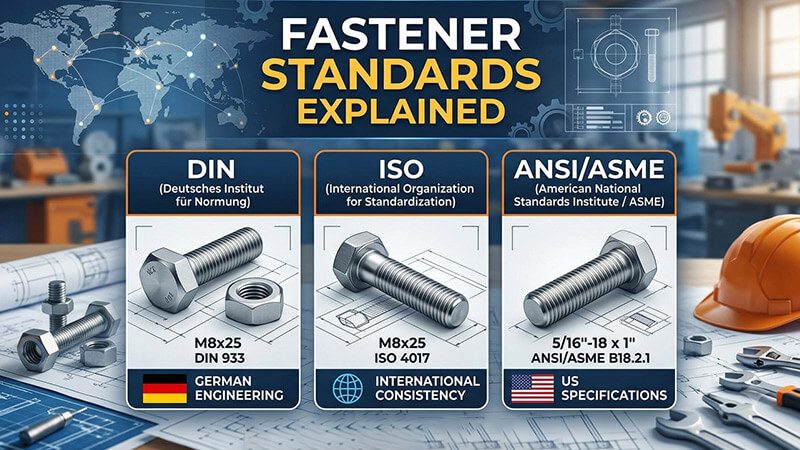
This guide cuts through the confusion. We’ll provide clear explanations of the four major global standards systems — DIN (Germany), ISO (International), ANSI/ASME/IFI (USA), and clarify their relationships — along with practical selection advice tailored for mechanical engineers, procurement professionals, and technical decision-makers worldwide. Along the way, you’ll find downloadable resources like the fastener standards manual PDF recommendation and insights into which standards work best for your specific application.
Global trade has fragmented fastener standards into regional systems, each with its own history, technical philosophy, and certification requirements. Understanding these systems isn’t just about compliance — it’s about ensuring that the bolts securing a wind turbine in Denmark, the brackets holding together machinery in Germany, or the anchors supporting a bridge in the United States all perform reliably under their intended loads.
At the heart of the challenge is this reality: a metric screw specification compliant with ISO may not interchange directly with its American counterpart, even if the nominal dimensions appear identical. Tolerances, thread profiles, strength grades, and testing methods vary significantly between standards systems.
The four dominant systems we’ll explore are:
| System | Region | Primary Body | Key Focus |
|---|---|---|---|
| DIN | Europe / Global German engineering influence | Deutsches Institut für Normung (German Institute for Standardization) | Precision engineering, metric-based specifications |
| ISO | Worldwide International harmonization | International Organization for Standardization | Global compatibility, metric standard adoption |
| ANSI/ASME/IFI | North America / US export markets | American National Standards Institute / American Society of Mechanical Engineers / Industrial Fasteners Institute | Imperial units, ASTM material specifications, rigorous testing protocols |
| ASTM | Material-specific standards across regions | ASTM International | Chemical composition, mechanical properties, testing procedures |
Let’s dive deeper into each system.
DIN fastener standards represent one of the world’s most respected engineering traditions. Originating in Germany, the DIN system has influenced countless industries beyond national borders, particularly in automotive, machinery, and precision equipment sectors.
DIN standards emphasize precision, reliability, and traceability. When you see a bolt marked with “DIN 933”, “DIN 931”, or “DIN 7991”, you’re looking at a component manufactured to German quality expectations that have been adopted by manufacturers worldwide — not just in Europe.
DIN 933 – Fully threaded hex cap screw (most common DIN bolt)
DIN 931 – Partially threaded hex cap screw
DIN 934 – Hex nuts (metric, prevailing type)
DIN 6921 – Hexagon flange nuts
DIN 7991 – Countersunk head socket screws (often used where flush mounting matters)
DIN 912 – Socket head cap screws (the quintessential DIN tool-drive fastener)
DIN uses a numerical grading system similar to ISO. For example:
Class 8.8 – Medium carbon steel, quenched and tempered
Class 10.9 – High tensile alloy steel, commonly used in structural applications
Class A2-70 – Stainless steel (A2 = 304-type; 70 = minimum tensile strength 700 MPa)
Projects requiring European market access or CE marking alignment
Applications where German-engineered quality is preferred (automotive, industrial machinery)
Supply chain partnerships with German manufacturers or suppliers quoting DIN specifications
Metric-based designs where European compatibility is desired
ISO fastener standards were created to reduce fragmentation and improve international interoperability. Many ISO standards directly mirror or supersede older national standards like DIN, making them increasingly the default choice for multinational projects.
With globalization accelerating, engineers prefer specifications that work across borders without modification. An ISO 4017 bolt purchased in Brazil should fit into an assembly designed in Japan and installed in Canada — provided all parties reference the same ISO number. This universality is exactly what ISO delivers.
ISO 4017 – Hexagon head screws (equivalent to DIN 931 partial-thread version)
ISO 4018 – Hexagon head screws fully threaded (equivalent to DIN 933)
ISO 4032 – Hex nuts (basic series, equivalent to DIN 934)
ISO 7380 – Button head socket screws
ISO 10642 – Full threaded hexagon socket head cap screws (longer than standard 7991)
ISO 898-1 – Mechanical properties of bolts, screws, and studs (strength classification system)
ISO follows the same numbering convention as DIN for strength grades:
Property Class 8.8 = medium carbon steel
Property Class 10.9 = high-strength alloy steel
Property Class A2-70 = austenitic stainless steel (equivalent to AISI 304)
International projects involving multiple countries
Equipment destined for global distribution where regulatory variation exists
Supply chains seeking standardized components regardless of origin
Designs prioritizing metric measurements with worldwide interchangeability
The ANSI/ASME/IFI fastener standards system represents the United States’ approach to fastener specification — a combination of consensus-based standards development, material science rigor, and extensive testing protocols. This is the standard you’ll encounter most frequently in North American infrastructure, oil & gas, aerospace, and heavy equipment sectors.
ANSI (American National Standards Institute) – Coordinates voluntary standards development across US industries
ASME (American Society of Mechanical Engineers) – Develops codes and standards for mechanical components, including fasteners used in pressure equipment (e.g., boiler applications)
IFI (Industrial Fasteners Institute) – Represents North American fastener manufacturers, publishes widely referenced dimension and torque specifications
ASTM International – Although technically separate, ASTM material specs often complement ANSI/ASME dimensional standards
ANSI B18.2.1 – Square and hex bolts and screws (the foundational US hex bolt spec)
ASME B18.2.2 – Square and hex nuts
ASME B18.3 – Socket head cap screws, shoulder screws, and set screws
ANSI B1.1 – Unified Inch Screw Threads (UNC/UNR profiles — the US counterpart to metric threads)
ASTM A325 – Structural bolts, heat-treated, inch sizes (used in steel construction)
ASTM A490 – Higher-strength structural bolts for critical connections
SAE J429 – Mechanical property requirements for externally threaded fasteners (grades 1, 5, 8)
If you’ve ever searched for grade 8 bolt specifications standard, you’ve encountered SAE J429 Grade 8 — the highest commercial-grade strength bolting available for general mechanical applications. Marked with six radial lines on the head, Grade 8 bolts feature:
Minimum tensile strength: 150 ksi (1034 MPa)
Minimum yield strength: 130 ksi (896 MPa)
Heat-treated alloy steel construction
Projects located in North America or subject to US regulatory requirements
Infrastructure projects governed by AISC (American Institute of Steel Construction) specifications using ASTM A325/A490 bolts
Applications demanding traceable material certifications and documented test results
Equipment designed with imperial unit dimensions throughout
Now for the centerpiece of this guide — a side-by-side comparison table summarizing the core differences between the four major systems. Use this quick-reference checklist when specifying fasteners for your next project.
| Feature | DIN (Germany) | ISO (International) | ANSI/ASME/IFI (USA) | ASTM (Material-Focused) |
|---|---|---|---|---|
| Primary Unit System | Metric (mm) | Metric (mm) | Imperial/inch (inches) | Supports both, depends on spec |
| Thread Form | Metric (ISO M profile per DIN EN ISO 68-1) | Metric (ISO M profile) | Unified Inch Thread (UNC/UNF per ANSI B1.1) | Depends on referenced standard |
| Head Types | Hex, socket countersunk, button, flange | Hex, socket, button, flange | Hex square, socket, carriage, carriage | Mostly dimensional, less focus on head style |
| Strength Classification | Property Classes (8.8, 10.9, etc.) | Property Classes (8.8, 10.9, etc.) | Grades (2, 5, 8 per SAE J429) | Grades (F568, F3125 per ASTM) |
| Common Reference Numbers | DIN 933, DIN 912, DIN 934 | ISO 4018, ISO 4017, ISO 7380 | ASME B18.2.1, B18.3, B18.2.2 | ASTM A325, A490, A307 |
| Typical Applications | Automotive, Machinery, General Engineering | Global/Multinational Projects | US Construction, Heavy Equipment, Aerospace | Material Certification for Critical Projects |
| Certification Traceability | Often includes material test reports | Generally consistent with traceability | Mill certs, lot traceability standard for structural grades | Mandatory material test reports for structural grades |
Never assume direct interchangeability between standards without verifying critical parameters:
Thread pitch tolerance — Even matching nominal diameters can have different pitch series
Head height and wrench clearance — Differences affect tool accessibility and aesthetic finish
Length measurement points — Some measure total length under head, others measure shank length
Coating and corrosion protection requirements — May differ by region or industry practice
For critical structural applications, always consult the governing building code or engineering specification before substituting across standards.
Selecting the appropriate fastener standard shouldn’t be guesswork. Follow this step-by-step decision framework tailored for your specific project context.
Where will the fastener be installed? What local codes apply?
European Union projects → Prioritize DIN or ISO (CE-marked products often require EN/DIN conformity)
North American infrastructure → Mandates typically specify ANSI/ASME dimensional specs paired with ASTM material grades
International multi-country deployments → ISO provides the widest compatibility
Projects following manufacturer OEM specs → Match whatever standard the original equipment designer specified
What stresses will the fastener experience?
Static, moderate loads → Property Class 8.8 / Grade 5 usually sufficient
Dynamic/vibrating loads → Consider lock nuts, prevailing torque features, or higher classes like 10.9 / Grade 8
Seismic, impact, or cyclic loading → Require higher safety factors and often specify ASTM A325/A490 structural bolts with certified mill test reports
Temperature extremes → Material selection becomes critical (avoid certain alloys at cryogenic or elevated temps)
Does space dictate shape? Do tools limit head type?
Limited access / recessed mounting → Socket head caps (DIN 912 / ISO 4762) or countersunk heads (DIN 7991)
High torque requirements → Larger drive sizes, thicker heads, external tooth lock washers
Corrosive environments → Specify stainless steel (A2-70, A4-80 per ISO 3506) or coated carbon steel with validated salt-spray ratings
Can you source the required standard locally? What’s the lead time?
Off-the-shelf availability: ANSI hex bolts, DIN 933, and ISO 4018 items typically carry ready stock in most industrial suppliers
Specialty standards (e.g., high-temp alloys, custom coatings) may require longer lead times or minimum order quantities
Local language support: Ordering in your native language through regional distributors reduces miscommunication risk
Will auditors or inspectors require documentation?
Critical structural connections → Always request mill test certificates (MTC) per EN 10204 Type 3.1 or 3.2
Quality-critical assemblies → Request batch traceability and material verification reports
Export-controlled industries → May need additional compliance statements regarding sanctions, origin, or technology controls
Engineers and procurement professionals often ask these questions when navigating fastener standards. Here are concise, practical answers.
Technically yes, but strongly discouraged unless specifically engineered. Different standards have varying tolerances on diameter, pitch, and head dimensions. Mixing them can compromise preload accuracy, increase wear on mating threads, and void warranty or inspection compliance. Whenever possible, standardize on one system per joint or subassembly.
In practice, the distinction is subtle. ANSI accredits standards developed by other organizations (like ASME or SAE). ASME develops its own consensus standards that become ANSI-approved when adopted. So you’ll see “ASME B18.2.1” published as an “ANSI B18.2.1” — they’re functionally identical for engineering purposes. The key is to cite whichever designation your project specification requires.
Ask for:
Product markings per standard (e.g., manufacturer logo, class marking per ISO 898)
Certificate of Conformance referencing the exact standard number
Third-party test reports if available for critical purchases
Sample inspection using calibrated go/no-go gauges for thread verification
Beware of counterfeit or “gray market” goods sold at suspiciously low prices — especially for high-strength grades like 10.9 or Grade 8.
No. A metric M12 bolt won’t fit an ANSI ½-inch hole precisely due to fundamental thread form differences (metric trapezoidal vs. unified triangular). Approximate equivalents exist for casual use, but never substitute in load-bearing applications without engineering verification.
ISO 898-1: Mechanical properties of bolts, screws, and studs — available via ISO Store
ANSI B18.2.1: Dimensions and tolerances — accessible through ASME or ANSI online libraries
IFI Handbook: Industrial Fasteners Institute publication with comprehensive data (search “IFI fastener standards handbook”)
Engineering Toolbox: Free online reference site (engineeringtoolbox.com) with conversion tables and typical values
Manufacturer websites like Bolt Depot and McMaster-Carr also offer helpful spec sheets
We understand that selecting the right fastener standards isn’t just theoretical — it impacts delivery timelines, budget, compliance, and ultimately, the success of your project. That’s why we’re here to help.
Our team specializes in supplying high-quality fastener solutions aligned with DIN, ISO, ANSI, and ASTM standards. Whether you need metric hex cap screws, specialized socket head cap screws, structural bolts with certified mill test reports, or custom-tailored solutions for unique applications, we deliver on time, every time.
Let’s discuss your fastener requirements today. Whether you’re sourcing for a single piece of equipment or managing large-scale procurement across multiple sites, our engineering and sales experts will work with you to identify the optimal fastener specifications, verify compliance, and ensure seamless integration into your design.
Submit Your Inquiry Now — tell us about your project scope, target standard, volume needs, and any special requirements. We’ll respond within 24 hours with personalized recommendations and competitive pricing.
Social Chat is free, download and try it now here!